


- By Admin
- 28 Sep, 2026
- Staff Augmentation
Why Companies Are Switching to Contract Developers
What Are Contract Developers?
Contract developers are software development professionals who work with a company for a defined period, project, or set of requirements. Unlike traditional permanent employees, their engagement is usually based on a contract.
A company may hire one developer to support its existing team, several developers for a project, or a dedicated development team for ongoing work.
Contract developers can work remotely and collaborate with internal teams, project managers, designers, and other professionals.
The exact engagement can vary according to the company's requirements. Some businesses may need full-time contract developers, while others may need part-time resources for a limited number of hours each week.
This flexibility is one of the major reasons businesses are considering contract developers as part of their workforce strategy.
Why Are Companies Switching to Contract Developers?
The move toward contract development is connected to changing business requirements. Companies want to remain flexible while still having access to development resources when they need them.
Some of the key reasons include:
Flexible team scaling
Faster access to developers
Better control over development costs
Remote working opportunities
Support for existing teams
Dedicated development teams
Part-time development options
Project-based resource requirements
Changing business priorities
Reduced dependency on permanent hiring
Let's look at these reasons in detail.
1. Flexible Team Scaling
One of the biggest advantages of contract developers is the ability to scale a development team according to project requirements.
A company's workload does not always remain constant.
During the early stages of a project, a business may need only a few developers. As development progresses, additional resources may be required. After a major development stage is completed, the company may need fewer developers.
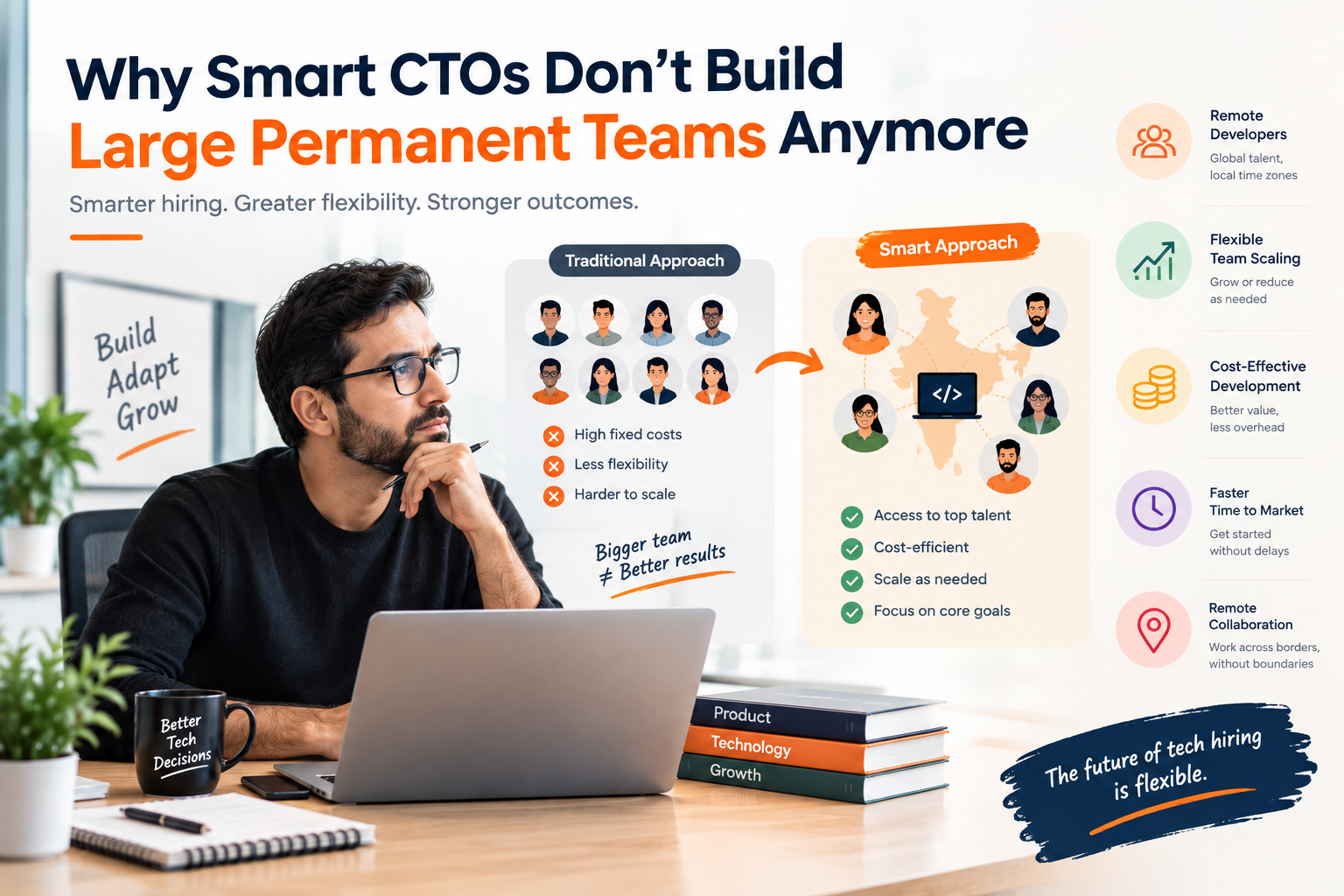
Traditional permanent hiring can make this difficult because employees remain part of the organization even when a particular project no longer requires the same level of development capacity.
Contract hiring provides more flexibility.
A business can start with one developer and add more resources as the project grows. Similarly, it can reduce the number of contract resources when additional support is no longer required.
This makes contract developers useful for companies with changing workloads.
2. Faster Access to Development Resources
Traditional recruitment can involve several steps.
A company may need to:
Create a job description
Publish the vacancy
Review applications
Shortlist candidates
Conduct interviews
Complete selection
Handle onboarding
Begin project work
This process can take considerable time.
However, projects often have their own deadlines. If a company needs additional developers quickly, waiting for a lengthy recruitment process may affect project schedules.
Contract hiring provides another way to increase development capacity.
Businesses can look for available developers according to their project requirements and start the engagement once the necessary arrangements are completed.
This can be especially useful when an existing team is overloaded or when a new project needs additional resources.
3. Better Control Over Development Costs
Cost management is another factor behind the growing interest in contract developers.
Permanent hiring can involve several expenses beyond salary. Depending on the organization and location, businesses may also have recruitment expenses, employee benefits, office-related costs, equipment, and other employment overheads.
For some projects, a company may not need a developer permanently.
If development support is required only for a particular project or period, contract hiring can provide an alternative.
Businesses can structure the engagement around their actual requirements.
For example, a company may choose:
Full-time contract development
Part-time development
One developer
Multiple developers
A dedicated team
A defined contract duration
This allows companies to plan development resources according to project requirements instead of maintaining a fixed team size for every situation.
4. Remote Development Is Easier
Remote work has changed the way companies build development teams.
Businesses are no longer limited to developers who live near their offices. Companies can collaborate with professionals working remotely from different locations.
Contract developers can become part of distributed teams and work with internal employees through online communication and project management systems.
This provides companies with more flexibility when searching for development resources.
A business can focus on the skills, experience, availability, and project requirements of a developer instead of making physical location the primary requirement.
5. Supporting Existing Internal Teams
Contract developers do not necessarily replace permanent employees.
In many situations, they work alongside an internal team.
For example, a company may have an internal development team working on an application. The team may already have a full workload, but a new project or additional requirements may create more work.
Instead of permanently expanding the internal team, the company can bring in contract developers.
The external developers can support the additional workload while the internal team continues managing its existing responsibilities.
This approach is commonly associated with IT staff augmentation.
6. Dedicated Development Teams
Some projects require more than one developer.
In these situations, companies may choose to hire a dedicated development team instead of adding individual resources separately.
A dedicated team can work continuously on a company's project according to an agreed engagement structure.
This model can be useful for:
New product development
Long-term development projects
Ongoing application development
Large development workloads
Businesses that need multiple developers
A dedicated team can also be scaled according to project requirements.
If additional resources are required later, the company can increase the team size. If requirements decrease, the team can be adjusted accordingly.
7. Part-Time Development Support
Not every business needs a developer for a full-time schedule.
A small business may have limited development requirements. A startup may need occasional development support. An established company may require additional resources for only a few hours each week.
Contract developers can support these requirements through part-time engagements.
Instead of hiring a full-time employee for limited work, companies can use developers for the hours they actually require.
For example, a flexible engagement may start from a limited number of hours per week and increase if the workload grows.
This makes contract development suitable for businesses with smaller or changing workloads.
8. Useful for Startups
Startups often need to balance product development with limited resources.
A startup may need developers to build its initial product but may not have the resources or requirements to create a large permanent development department.
Contract developers can provide an alternative.
A startup can begin with a small number of developers and increase the team when the product grows.
For example:
Stage 1: One developer supports initial development.
Stage 2: Additional developers are added as development requirements increase.
Stage 3: A dedicated team supports ongoing product development.
This approach gives startups flexibility as their requirements change.
9. Useful for Established Companies
Contract developers are not only useful for startups.
Large companies can also use contract development resources.
An established company may have a permanent internal team but require additional developers for a specific project.
For example, the company may launch a new digital product while continuing to maintain its existing applications.
The internal team may not have enough capacity to handle everything simultaneously.
Contract developers can provide additional development capacity without requiring the company to permanently increase its internal workforce.
10. Support for Short-Term Projects
Some development projects have a clearly defined timeline.
A company may need additional developers for several months to complete a particular development phase.
Hiring permanent employees for a short-term requirement may not always align with the project's structure.
Contract developers can work for the required period and support the project until the agreed development requirements are completed.
This can make resource planning more closely aligned with the project timeline.
11. Support for Long-Term Projects
Contract development is not limited to short-term engagements.
Businesses can also use contract developers for longer projects.
A company may require a remote developer or dedicated team for several months or longer.
Longer contract engagements can provide continuity while still giving the business flexibility around its workforce structure.
For businesses that need ongoing development but prefer a contract-based model, this can be a useful option.
12. Easier Workforce Planning
Workforce requirements can change as a business grows.
A company may not know exactly how many developers it will need six months or one year from now.
Maintaining a fixed permanent team can make it difficult to adjust quickly.
Contract developers can provide a more adaptable workforce structure.
Companies can plan resources according to:
Current workload
Project timeline
Development requirements
Available budget
Required team size
Expected project duration
This can make technology workforce planning more flexible.
13. Access to a Wider Talent Pool
Traditional hiring often focuses on a company's local market.
Remote contract development allows businesses to search beyond their immediate geographical area.
This can be especially useful when local hiring does not provide enough available candidates for a particular project.
Companies can consider remote developers from different locations and select resources based on their project requirements.
For businesses using remote staffing models, this can expand the available talent pool.
14. Faster Project Development
When an internal team does not have enough capacity, development work can take longer.
Adding contract developers can provide additional resources for the project.
The additional developers can help distribute the workload and support the existing team.
This does not automatically guarantee faster delivery, because project outcomes depend on many factors, including planning, communication, requirements, and team coordination.
However, adding resources when a team is overloaded can provide additional development capacity.
15. Flexible Contract Terms
One of the main differences between permanent hiring and contract development is the flexibility of the engagement.
Companies can structure contracts based on their specific requirements.
For example, a business may need:
One Developer
A single developer can support an existing internal team.
Multiple Developers
Several developers can be added when a project has a larger workload.
Dedicated Team
A dedicated remote team can provide ongoing project support.
Part-Time Developer
A developer can work fewer hours when full-time support is unnecessary.
These different options allow companies to select an engagement model based on their actual needs.
16. Contract Developers and IT Staff Augmentation
Contract developers are often used as part of an IT staff augmentation model.
Staff augmentation allows companies to add external developers to their existing teams.
The company maintains its internal team while additional developers provide support.
This can be useful when:
Project workload increases
Internal teams need additional capacity
A company needs temporary development resources
A new project requires additional developers
The business wants to scale its team
The model provides flexibility without requiring the company to permanently expand its internal workforce.
17. Why Companies Are Moving Toward On-Demand Hiring
Modern businesses increasingly need resources when they need them.
A company may not require five developers throughout the year. It may need five developers during one project stage and fewer resources later.
This is where on demand hire (https://www.webwiders.com/on-demand-hire/) becomes relevant.
An on-demand hiring approach allows businesses to add remote developers or teams according to their current requirements.
For example, a company can hire one developer to support an existing team. If the project grows, additional developers can be added.
Similarly, businesses can choose part-time resources when they do not need full-time support.
This provides an adaptable approach to technology staffing.
18. Contract Developers Can Complement Permanent Employees
A common misconception is that businesses must choose between permanent employees and contract developers.
In reality, companies can use both.
A company may have a permanent core team responsible for its long-term technology strategy while contract developers provide additional project support.
For example:
Permanent Team
Manages core business applications and long-term responsibilities.
Contract Developers
Support additional development work and project requirements.
Dedicated Team
Handles a larger project or specific development workload.
This combination can give businesses more flexibility in managing their technology workforce.
19. What Businesses Should Consider Before Hiring Contract Developers
Contract development provides flexibility, but businesses should still plan carefully.
Before hiring developers, companies should define their requirements.
Project Scope
Clearly explain what needs to be developed and what responsibilities the developer or team will handle.
Team Size
Decide whether the project needs one developer, several developers, or a dedicated team.
Working Hours
Determine whether full-time or part-time support is required.
Contract Duration
Define how long the developers are expected to work on the project.
Communication
Set clear communication channels, meeting schedules, reporting structures, and project responsibilities.
Budget
Establish the available development budget and select an engagement structure accordingly.
Clear requirements can make it easier to establish an effective working relationship with contract developers.
20. How to Manage a Remote Contract Development Team
Once developers are hired, proper management is important.
Businesses should establish clear communication from the beginning.
Regular project meetings can help everyone understand progress and upcoming tasks.
Project documentation should also be maintained so developers understand requirements and responsibilities.
Companies can establish:
Regular meetings
Project milestones
Task assignments
Progress updates
Communication channels
Defined responsibilities
Development schedules
These practices can help internal and external teams work together more effectively.
21. When Should a Company Consider Contract Developers?
Contract developers may be useful when a business:
Has an increase in project workload
Needs additional development capacity
Wants to support an existing team
Is starting a new project
Needs developers for a defined period
Requires part-time development support
Wants to build a dedicated remote team
Needs flexibility in team size
Wants to access remote development resources
The right approach depends on the company's individual requirements.
22. Contract Developers for Growing Businesses
As a company grows, its technology requirements can change.
A small team may initially be enough. Later, the company may need additional developers to support new products, features, or customers.
Contract development can provide a flexible way to increase resources during growth periods.
Instead of building a large permanent team immediately, a company can add developers according to its workload.
This allows development capacity to grow alongside business requirements.
23. The Role of Flexible Hiring in Modern IT
Technology businesses increasingly need flexibility.
Project requirements change. Product priorities change. Development workloads change.
A fixed workforce structure may not always match these changes.
Flexible hiring models provide businesses with another way to manage development resources.
Contract developers, staff augmentation, dedicated teams, and part-time resources can all be used depending on the project.
The goal is not simply to replace permanent hiring but to create more options for managing development teams.
How Webwiders Supports Contract-Based Developer Hiring
Webwiders provides flexible IT staff augmentation and remote contract-based development options for companies that need additional development resources.
Businesses can hire a remote developer or hire a team according to their project requirements.
For full-time staff augmentation, developers are available for 40 hours per week for three or more months, on a remote contract basis.
Businesses that require a larger team can also hire a dedicated team of IT experts. The dedicated team model is available with at least two or more developers, with 40 hours per week per developer.
For businesses that require fewer working hours, Webwiders also provides part-time development support, with a minimum of 10 hours per week and a pay-as-you-go model.
These options provide businesses with different ways to structure their development teams.
Flexible Team Scaling
Businesses can add a remote developer or team according to their current project requirements and adjust resources as requirements change.
Faster Expert Hiring
Companies can access development resources without going through the complete process of building a permanent internal team.
Cost-Effective Quality
Contract-based development allows businesses to use development resources while reducing the need for some of the overhead associated with permanent employment.
Dedicated Team Support
Businesses can hire a dedicated remote development team for projects that require multiple developers working toward common goals.
Faster Project Delivery
Additional developers can provide support when an existing team has a higher workload or a project requires more development capacity.
Flexible Contract Terms
Businesses can adjust team size and engagement duration according to their project requirements.
Contract Developers vs. Permanent Developers
Both contract and permanent developers can play an important role in a company's technology strategy.
The right option depends on the organization's requirements.
| Requirement | Contract Developers | Permanent Developers |
|---|---|---|
| Short-term project | Suitable for flexible engagement | May involve a longer commitment |
| Changing workload | Easier to scale resources | Team size may be more fixed |
| Part-time requirement | Can support limited hours | Usually structured as full-time employment |
| Existing team support | Can be added through staff augmentation | Requires additional permanent hiring |
| Dedicated project | Can provide dedicated resources | Can be part of internal development |
| Long-term internal role | Depends on contract structure | Designed for permanent employment |
Companies do not necessarily have to choose only one model. A combination of permanent employees and contract developers can be used depending on business requirements.
The Future of Contract Development
The way companies build technology teams continues to evolve.
Businesses are increasingly looking for flexible ways to access development resources while managing changing workloads.
Remote work, staff augmentation, dedicated development teams, and contract-based hiring provide companies with more choices than traditional recruitment alone.
Contract developers can support startups, growing businesses, and established organizations.
They can work as individual resources, support existing teams, or become part of dedicated development groups.
As project requirements continue to change, flexibility will remain an important consideration for companies managing technology teams.
Final Thoughts
Companies are switching to contract developers because they need more flexibility in how they build and manage technology teams. Contract resources can support changing workloads, provide additional development capacity, enable remote collaboration, and offer different engagement structures for businesses with different requirements.
Instead of maintaining the same team size throughout every stage of a project, businesses can adjust resources according to their workload. They can hire one developer, add multiple developers, build a dedicated team, or use part-time development support.
For companies that want to respond quickly to changing development requirements, on demand hire provides a flexible approach to adding remote developers or teams when additional resources are needed.
Frequently Asked Questions
1. What are contract developers?
Contract developers are IT professionals hired for a specific project, period, or development requirement. They may work remotely and can support an existing team or work as part of a dedicated development team.
2. Why are companies switching to contract developers?
Companies are switching to contract developers because they can provide flexible team scaling, remote development support, additional project capacity, and different engagement options based on business requirements.
3. Can contract developers work with an existing internal team?
Yes. Contract developers can work alongside permanent employees through IT staff augmentation. They can provide additional development capacity while the internal team continues managing its existing responsibilities.
4. Can companies hire contract developers part-time?
Yes. Companies can hire developers on a part-time basis when they do not require full-time development support. This can be useful for smaller projects or limited development requirements.
5. What is on demand hire for developers?
On demand hire is a flexible hiring approach that allows companies to add remote developers or teams according to their current requirements. Businesses can use it to increase development capacity, support projects, or adjust team size without making every resource a permanent hire.