


- By Admin
- 21 Sep, 2026
- Staff Augmentation
Why Global Companies Hire Developers from India
Why India Has Become a Popular Destination for Developers
India has a large and established IT industry with professionals working on software development and technology projects for businesses across different markets.
The country's development ecosystem supports both large enterprises and smaller businesses. This allows international companies to explore different hiring options based on their project size, timeline, and resource requirements.
A company may need one developer to support an existing team, while another business may require a complete development team for a new product. Flexible hiring models make it possible to address both situations.
For global companies, the ability to access remote developers from another country also means that hiring does not have to be restricted to the local talent market.
1. Access to a Large IT Talent Pool
One of the major reasons companies look toward India is access to a large pool of IT professionals.
When businesses recruit only within their local market, the number of available candidates can be limited. This becomes particularly challenging when a company needs several developers within a short period.
Working with developers in India gives companies another source of technical talent.
Businesses can select resources based on factors such as:
Project requirements
Experience level
Availability
Working hours
Engagement duration
Number of developers required
Full-time or part-time requirements
This flexibility can help companies build development teams according to their actual needs rather than hiring a fixed number of employees.
2. Flexible Remote Development
Remote work has changed the way businesses build technology teams.
A company does not necessarily need developers to work from its own office. Developers can work remotely while collaborating with project managers, internal employees, designers, and other team members located in different countries.
Indian developers can therefore become part of distributed international teams.
Remote development can be useful for companies that want to:
Expand an existing development team
Add resources for a specific project
Continue development work remotely
Build a dedicated development team
Get part-time development support
Scale resources as requirements change
This model can provide businesses with more flexibility in managing their technology workforce.
3. Cost-Effective Development Support
Development costs are an important consideration for many companies.
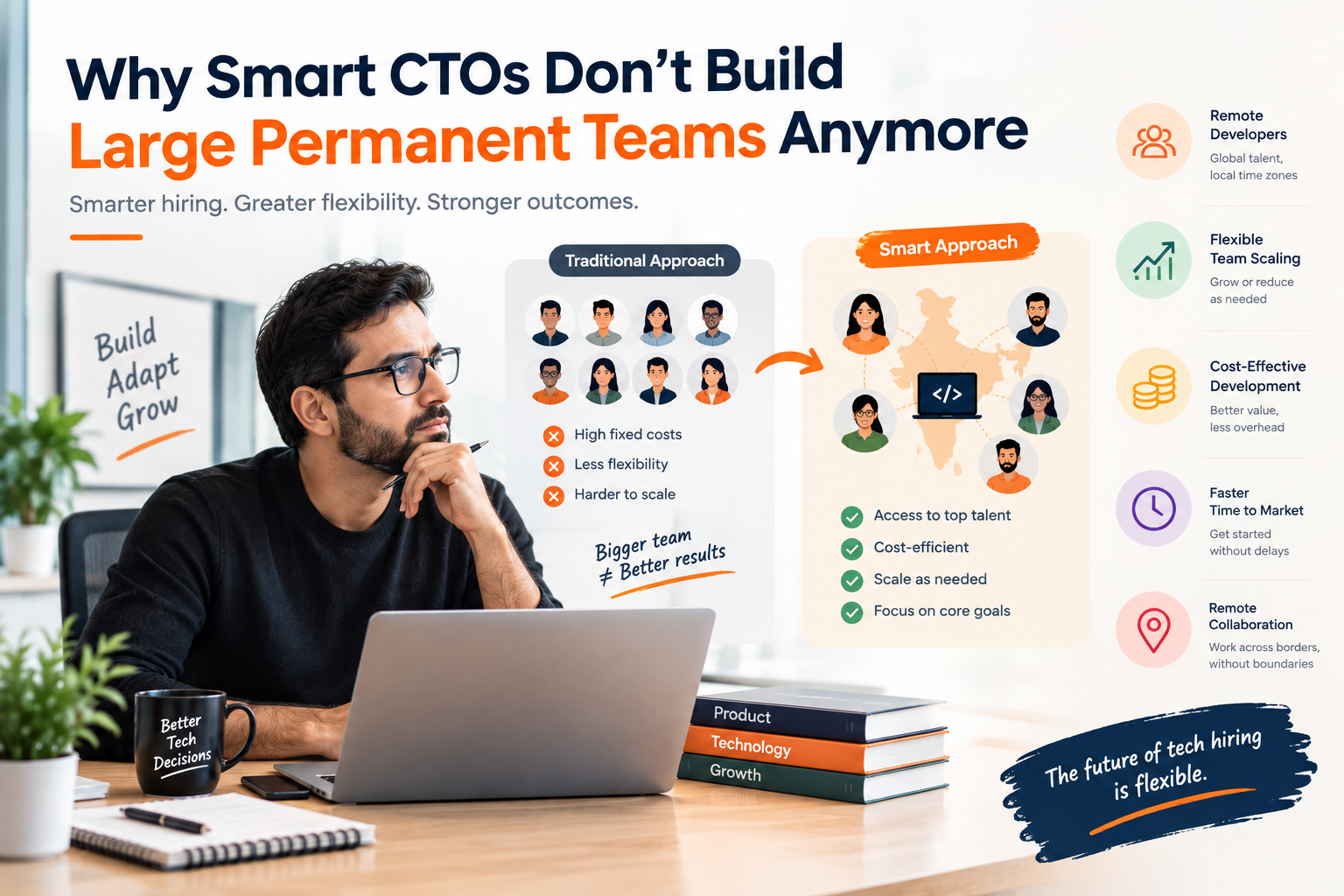
Hiring a full-time employee involves more than the employee's salary. Businesses may also have recruitment expenses, office-related costs, employee benefits, equipment expenses, and other operational costs.
For companies that only need additional developers for a particular project or period, permanent hiring may not always be the preferred approach.
Contract-based remote development provides another option.
Businesses can engage developers according to their project requirements and choose an engagement structure that fits their needs.
This does not simply mean focusing on lower costs. Companies also need to consider development quality, communication, availability, project requirements, and long-term collaboration when choosing a development partner.
4. Faster Access to Development Resources
Technology projects often operate according to deadlines.
If an internal team does not have enough developers, a project may require additional resources. Traditional recruitment can take time because companies need to advertise positions, review applications, conduct interviews, select candidates, and complete onboarding.
Flexible remote hiring can reduce some of the delays involved in expanding a development team.
Instead of building a completely new permanent team, a company can add remote developers or a dedicated team according to its immediate requirements.
For businesses working with strict project timelines, having access to additional development resources can make it easier to manage workloads.
5. Ability to Hire a Single Developer
Not every project requires a large team.
Sometimes a business already has a development team but needs one additional developer to increase capacity or support a particular requirement.
In such situations, hiring an entire team may not be necessary.
Companies can choose to hire a single remote developer on a contract basis.
This approach can be useful when:
An internal team needs additional support
A project requires temporary development capacity
A developer is needed for a defined period
The company wants to test a flexible engagement model
Additional workload needs to be distributed
The company can therefore increase its development capacity without changing the structure of its entire internal team.
6. Dedicated Development Teams
Larger projects may require multiple developers working together.
A dedicated development team can provide a more structured approach to remote development. Instead of hiring individual resources separately, businesses can build a team around their project requirements.
A dedicated team can be particularly useful when a company needs continuous development support.
The team can work toward specific project goals while the business maintains communication with the development resources.
Companies may also adjust the size of the team as their requirements change.
For example, a business may initially need a small team and later add additional developers as the project grows.
7. Flexible Contract-Based Hiring
One of the biggest advantages of flexible hiring is that companies do not have to follow the same hiring structure for every project.
Different projects have different requirements.
A business may require:
One developer:
For additional support to an existing team.
Multiple developers:
For a larger development requirement.
A dedicated team:
For continuous development and project support.
Part-time resources:
When full-time development support is not required.
Contract resources:
When developers are needed for a specific period or project.
This flexibility allows companies to match their development resources with their actual workload.
8. Part-Time Development Support
Some businesses do not need developers for a traditional full-time schedule.
For example, a company may have a smaller development requirement or need additional support for a limited number of hours each week.
A flexible part-time engagement can provide an alternative.
With a pay-as-you-go approach, companies can use development resources according to their requirements rather than committing to a full-time hiring arrangement.
This can be particularly useful for smaller businesses, startups, or companies with changing project workloads.
9. Easy Team Scaling
Technology projects can change significantly over time.
During the initial stages, a business may need only a few developers. As development progresses, additional resources may become necessary.
Later, once major development work is completed, the required team size may decrease.
Flexible staff augmentation makes this type of scaling easier.
Companies can increase or decrease their development resources based on project requirements instead of maintaining the same team size throughout the entire project.
This provides businesses with greater workforce flexibility.
10. Supporting Existing Internal Teams
Hiring developers from India does not necessarily mean replacing an internal development team.
Many companies use remote developers to complement their existing teams.
For example, an internal team may already be working on a product but have limited capacity to handle additional development tasks.
A remote developer or dedicated team can provide additional support.
The internal team can continue managing its core responsibilities while external resources contribute to the additional workload.
This model is commonly associated with staff augmentation, where businesses add external resources to their existing teams according to their requirements.
11. Supporting Startups and Growing Businesses
Startups often need to move quickly while managing limited resources.
A new company may need developers to build its product but may not be ready to establish a large permanent development department.
Flexible remote hiring can provide another way to access development resources.
A startup can begin with a smaller number of developers and expand the team as the product and business grow.
This can help the company avoid building a large development organization before it actually needs one.
For growing businesses, the ability to scale development resources can be particularly useful.
12. Useful for Established Companies
Flexible development hiring is not limited to startups.
Established companies can also need additional development resources when they launch new products, expand existing applications, or have increased project workloads.
An enterprise may already have an internal technology department but still require additional developers for a specific project.
Instead of permanently increasing its internal workforce, the company can use contract-based remote resources.
This provides an additional layer of flexibility while allowing the existing team to continue its regular responsibilities.
13. Global Remote Collaboration
Modern software projects often involve people from multiple locations.
A project may have business managers in one country, designers in another, and developers working remotely from India.
With appropriate communication and project management practices, these teams can work together across geographical boundaries.
Regular meetings, clear project responsibilities, documentation, and communication processes can help keep distributed teams aligned.
Remote collaboration also allows companies to build teams based on skills and project requirements rather than limiting recruitment to people who live near a physical office.
14. Flexible Working Hours
Different companies have different working schedules.
When working with remote developers, businesses can discuss working hours and collaboration requirements according to the project.
This can be especially useful for companies with international teams.
A development team in India can work remotely while coordinating with teams in other locations through planned meetings and communication channels.
The important factor is to establish clear expectations around availability, communication, deadlines, and project responsibilities.
15. Development Resources for Different Project Stages
Software development involves different stages and workloads.
During one stage, a company may require a small development team. During another stage, additional developers may be needed.
For example, a company may start with a limited team while planning its product. Once development begins, it may need more resources. Later, it may reduce the team when major development activities are completed.
Flexible hiring allows businesses to adjust their development capacity throughout these stages.
This is one of the reasons contract-to-contract and staff augmentation models can be useful for businesses with changing project requirements.
16. Focus on Business Requirements
Hiring developers internationally should not be based only on location.
Companies need to consider the actual requirements of their project.
Before hiring developers from India, a business should clearly define:
What needs to be developed
How many developers are required
How long the resources will be needed
Whether full-time or part-time support is required
Whether the company needs an individual developer or a team
How the remote team will communicate
What project responsibilities will be assigned
Having clear requirements makes it easier to select an appropriate engagement model.
17. On Demand Hiring for Changing Requirements
One of the important developments in modern IT staffing is the move toward flexible resource models.
Companies do not always know exactly how many developers they will need several months from now. Project requirements can change as products develop and business priorities shift.
An on demand hire model allows businesses to add development resources when they need them.
For example, a company can hire one developer for additional project support and later increase the team when the workload grows.
Similarly, a company may choose part-time support when it does not require full-time development capacity.
This approach gives businesses more flexibility compared with maintaining a fixed development workforce for every project.
18. Why Remote Contract Hiring Can Be Practical
Remote contract hiring can provide a middle ground between completely internal development and outsourcing an entire project.
The company can remain involved in project management and decision-making while adding external developers to its team.
This can be useful when a business wants to maintain control over its project but needs additional development capacity.
The model can also work alongside an existing internal team.
For example:
Internal Team + Remote Developer
The company keeps its existing team and adds one external developer.
Internal Team + Dedicated Remote Team
The company keeps its core team while an external dedicated team supports a larger development workload.
Remote Team
A company can also use a remote team for a project where flexible external development support is appropriate.
19. What Companies Should Consider Before Hiring Developers from India
Although India provides access to a large technology talent pool, companies should still carefully evaluate potential development resources.
Some important considerations include:
Project Experience
Review whether the developer or team has experience relevant to the project's requirements.
Communication
Clear communication is essential for remote collaboration. Companies should establish communication channels and expectations before development begins.
Availability
Confirm the developer's working hours, availability, and expected engagement period.
Team Structure
Determine whether the project requires one developer, multiple developers, or a dedicated team.
Engagement Model
Choose between full-time, part-time, contract-based, or other flexible arrangements based on the actual project requirement.
Project Ownership
For long-term projects, businesses should clearly define responsibilities, deliverables, documentation, and ownership arrangements.
20. The Future of Hiring Developers from India
The global technology workforce is becoming increasingly distributed.
Companies can now build teams across different countries instead of relying entirely on local recruitment. This gives businesses more flexibility when searching for development resources.
India is well positioned within this global development ecosystem because of its established IT industry and large pool of technology professionals.
The future of developer hiring is likely to involve more flexible engagement models, remote collaboration, staff augmentation, dedicated teams, and project-based development.
Businesses will continue to look for ways to increase their development capacity while maintaining control over costs, timelines, and team structures.
How Webwiders Supports Flexible Developer Hiring
For businesses looking for remote development resources, Webwiders provides flexible IT staff augmentation and contract-based hiring options.
Companies can hire a remote developer or a team based on their project requirements.
For full-time staff augmentation, developers are available for 40 hours per week for three or more months, on a remote contract basis.
Businesses can also hire a dedicated team of IT experts, with at least two or more developers and 40 hours per week per developer.
For projects that require fewer working hours, Webwiders also supports part-time development resources, starting from a minimum of 10 hours per week with a pay-as-you-go model.
These options allow businesses to select an engagement model based on the size and duration of their development requirements.
The key benefits include:
Flexible Team Scaling: Add or reduce resources based on project requirements.
Faster Expert Hiring: Access development resources without going through a complete permanent recruitment process.
Cost-Effective Quality: Use contract-based resources without the overhead associated with full-time employment.
Full-Scale Team Support: Build a dedicated remote development team for larger projects.
Faster Project Delivery: Add resources when an existing team needs additional development capacity.
Flexible Contract Terms: Adjust team size and engagement duration according to business requirements.
India as a Flexible Option for Global Development Teams
The decision to hire developers from India depends on each company's requirements, project structure, budget, timeline, and preferred engagement model. However, remote development and flexible IT staffing have made it easier for businesses to access developers beyond their local markets.
Companies can choose between hiring a single developer, adding multiple resources, building a dedicated team, or using part-time development support.
For businesses that need to scale their development teams without making every resource a permanent hire, these flexible models can provide a practical approach to managing changing technology requirements.
As companies continue adopting distributed teams, remote development, and flexible staffing models, hiring developers from India can remain one of the options businesses consider when looking to expand their technology capabilities.
Frequently Asked Questions
1. Why do global companies hire developers from India?
Global companies hire developers from India to access a large IT talent pool and flexible remote development resources. Companies can choose individual developers, multiple resources, or dedicated teams according to their project requirements.
2. Can companies hire developers from India remotely?
Yes. Companies can work with Indian developers through remote and contract-based engagement models. Remote collaboration allows developers to work with international teams without being physically located in the company's office.
3. Can a company hire a dedicated development team from India?
Yes. Businesses can hire dedicated remote development teams when a project requires multiple developers working toward common goals. Team size and engagement duration can be structured according to project requirements.
4. Can companies hire Indian developers part-time?
Yes. Businesses that do not require full-time development support can use part-time hiring models. This can be useful when a company needs development support for a limited number of hours per week.
5. What is an on demand hire model for developers?
An on demand hire model allows businesses to add remote developers or development teams according to their current requirements. It can help companies scale development capacity, support specific projects, and adjust team size without committing every resource to permanent employment.